

MDH Grade Selection for EVA and HFFR: VB-2AS vs VB-3CH-A
PE and EVA HFFR cable compounds can use the same magnesium hydroxide (MDH) flame-retardant family, but they do not always need the same MDH specification.
For PE cable jackets, particle control can become important when a smoother extrusion surface is required. In high-filled EVA, dispersion and mineral-polymer interaction may place more attention on surface treatment.
Victoryfr’s VB-2AS and VB-3CH-A TDS provide two different starting points for these formulation needs.
For EVA and PE HFFR compounds, the useful comparison is not which MDH grade is better overall, but which specification matches the current processing problem.
Why Compare the TDS Before Choosing an MDH Grade?
A standard MDH grade may work well until the resin, filler level, or production target changes.
A PE formulation may meet its flame requirement but still show an uneven cable surface. An EVA formulation may process normally at one filler level but become difficult to disperse when mineral loading increases.
In both cases, changing the MDH grade can be more targeted than changing several formulation variables at once.
The TDS helps identify which difference is worth testing first.
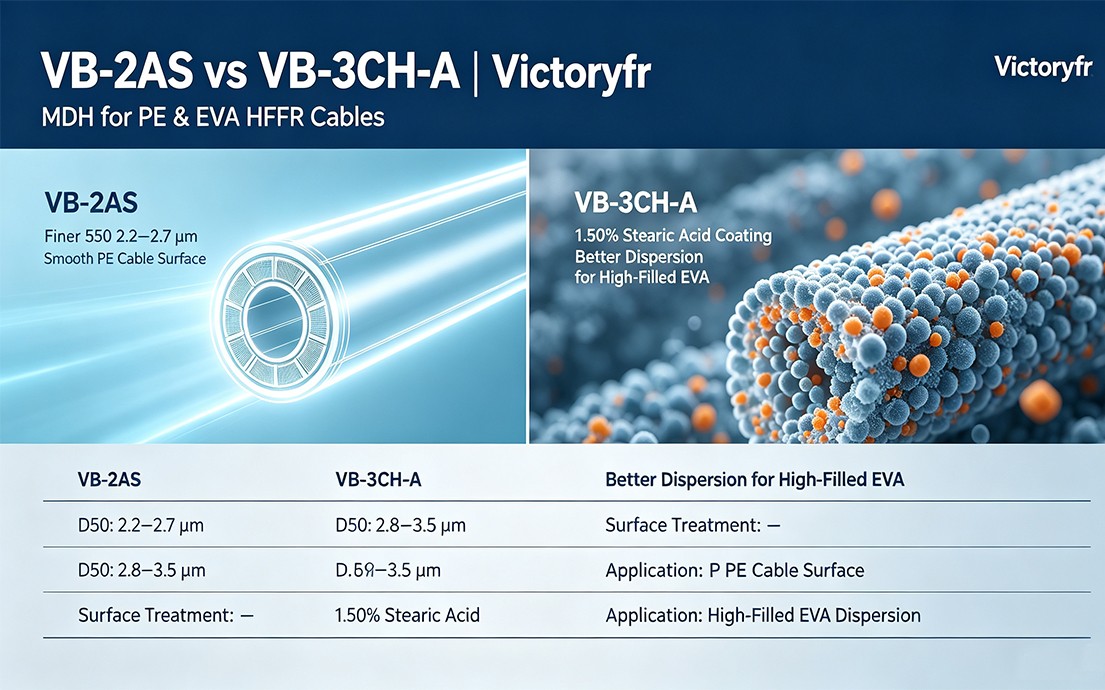
VB-2AS vs VB-3CH-A: What Is Different?
Both products are magnesium hydroxide grades listed for HFFR and PVC cable jacketing and insulation.
TDS item | VB-2AS | VB-3CH-A |
Whiteness | >92 | >90 |
D50 | 2.2–2.7 μm | 2.8–3.5 μm |
MgO | 63–64% | 58–60% |
Loss on Ignition | ≥28% | ≥28% |
Moisture | ≤0.5% | ≤0.5% |
Specific gravity | 2.4 g/cm³ | 2.4 g/cm³ |
Stearic-acid coating | Not specified in the reviewed TDS | 1.50% |
The main selection difference is clear.
VB-2AS provides the finer stated D50 range. VB-3CH-A adds a defined stearic-acid surface treatment.
These differences do not define a universal “PE grade” or “EVA grade.” They become useful when linked to a specific formulation problem.
For PE, particle control and cable surface quality may deserve more attention. For high-filled EVA, surface treatment may become more relevant when dispersion starts to limit processing.
PE Cable Surfaces: Start With Particle Control
PE cable compounds can show rough or uneven surfaces even when the flame-retardant system is already working.
In this case, particle size is one of the first MDH variables to review.
VB-2AS specifies a D50 of 2.2–2.7 μm, while VB-3CH-A specifies 2.8–3.5 μm. This makes VB-2AS a relevant option when the formulation needs tighter particle control.
A fair trial should keep the PE resin and filler loading unchanged.
Check the result through:
● dispersion;
● extrusion stability;
● finished cable surface.
A finer D50 is not a guarantee of a smoother cable. It simply gives the formulator a clearer direction when particle behavior is already suspected to be part of the problem.
High-Filled EVA: Put Surface Treatment on the Trial List
The selection logic changes when the main issue is poor dispersion at high mineral loading.
In high-filled EVA, changing particle size alone may not solve the problem. The interaction between MDH and the polymer matrix also needs attention.
VB-3CH-A specifies 1.50% stearic-acid coating. This makes it a relevant trial option when the formulation shows poor dispersion, unstable processing, or difficulty maintaining mechanical properties.
The first comparison should keep the EVA resin, filler loading, and additive package unchanged.
The purpose is to see whether the surface-treated MDH improves the original processing problem.
These two routes address different priorities: VB-2AS is more relevant when particle control is the main variable. VB-3CH-A provides a surface-treated route when filler-polymer interaction needs more attention.
What If the Formulation Needs Both?
Ultrafine and Surface-Modified Are Not Opposite Choices. Some custom LSZH formulations require more than one adjustment.
A PE formulation may need tighter particle control but also show dispersion problems at high loading. An EVA formulation may benefit from surface treatment while still requiring a different particle range.
In these cases, the choice should not be limited to “ultrafine” or “surface-modified.”
Victoryfr supports different particle specifications and surface-modification routes for polymer formulations. Its technical support also covers particle-size selection, dosage, and formulation adjustment for systems including PE and EVA.
This is relevant when an existing standard grade does not fully meet the required surface, dispersion, or processing target.
How to Compare VB-2AS and VB-3CH-A in a Trial
The first comparison should stay simple.
1. Use the same PE or EVA resin.
2. Keep MDH loading and the additive package unchanged.
3. Change only the MDH grade in the first trial.
4. Compare the production issue that triggered the trial.
For a PE surface project, focus on dispersion, extrusion stability, and jacket appearance.
For a high-filled EVA project, give more attention to dispersion, processing behavior, tensile strength, and elongation.
If one grade improves the target issue, further adjustments to loading or formulation can follow in the next trial.
This keeps TDS selection connected to the actual cable problem rather than turning the comparison into a purely numerical exercise.
How Victoryfr Supports MDH Grade Selection
Before recommending a trial direction, the supplier needs more than the resin name.
Useful project information includes:
● PE or EVA grade;
● current MDH specification;
● filler loading;
● extrusion temperature;
● current surface or dispersion problem;
● required mechanical properties.
For a PE formulation focused on surface quality, Victoryfr can evaluate particle-size requirements around the existing processing conditions.
For high-filled EVA where dispersion is more important, a surface-treated route such as VB-3CH-A can be evaluated first.
Custom formulations can then be adjusted around particle characteristics, surface treatment, and dosage instead of moving directly to another general-purpose grade.
FAQ
Which Victoryfr MDH grade is relevant for smoother PE cable surfaces?
VB-2AS is a relevant candidate when finer particle control is a priority because its TDS specifies a D50 of 2.2–2.7 μm. Final surface quality still needs to be checked under the actual PE extrusion conditions.
Is VB-3CH-A automatically better for high-filled EVA?
No. VB-3CH-A is relevant when surface treatment needs to be evaluated because its TDS specifies 1.50% stearic-acid coating. Its suitability depends on the EVA resin, filler loading, and processing problem.
Can the same MDH grade be used for both EVA and PE?
Yes. Both TDS documents list HFFR cable applications. The grade should be selected according to the specific particle, dispersion, surface, and processing requirements of each formulation.
What if a standard MDH grade does not solve the problem?
Review the limiting variable first. If the problem is mainly surface quality, particle characteristics may need adjustment. If dispersion or polymer compatibility is limiting the formulation, surface treatment may need more attention.
Conclusion
Victoryfr provides two defined MDH qualification routes for PE and EVA HFFR cable compounds. VB-2AS offers a finer stated particle-size range, while VB-3CH-A provides a defined 1.50% stearic-acid surface treatment.
For PE and EVA projects, Victoryfr can support MDH selection through particle-size control, surface modification, and formulation adjustment, with the selected grade verified under actual compounding and extrusion conditions.
