

Ultra-Fine Brucite-Derived Magnesium Hydroxide D50 1.5–2.5 μm for High-Loading Rubber Compounds
Past roughly 150 phr, magnesium hydroxide stops being an additive and becomes the dominant phase of the compound — and the grade that holds up at that level is an ultra-fine brucite-derived magnesium hydroxide with D50 1.5–2.5 μm. Everything your customer notices — elongation, surface finish, scrap rate — now depends on that particle system. Here is how we approach that choice, and the checks that keep a magnesium hydroxide flame retardant working at production scale.
Why particle size decides the outcome in rubber
⟨anchor: particle-size-rubber⟩
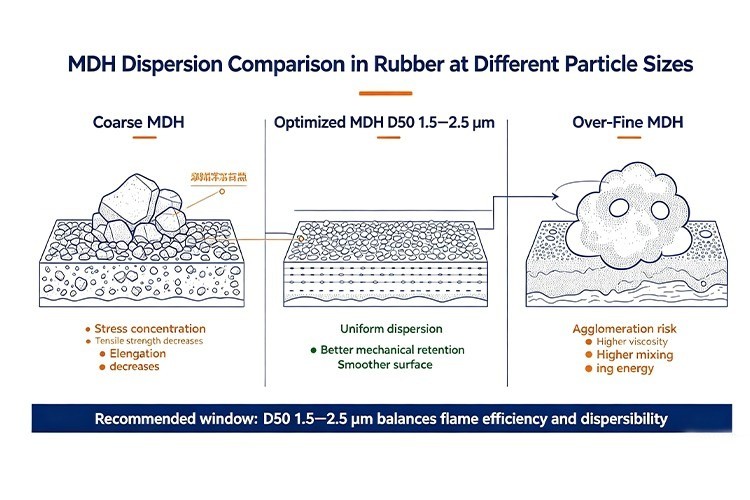
Coarse MDH particles act as stress concentrators: tensile strength, elongation at break and flex fatigue all fall, and extruded or calendered surfaces turn rough. Go too fine and the problem flips — agglomeration, higher viscosity and expensive mixing energy — unless the grade is engineered and treated for the specific rubber system.
The D50 window of 1.5–2.5 μm is the practical compromise for a magnesium hydroxide flame retardant at high loading: enough specific surface for flame efficiency per phr, yet still dispersible in an internal mixer or open mill within normal cycle times. Two more numbers matter as much as D50: a controlled D97, and low, stable moisture from lot to lot.
Brucite-derived versus precipitated MDH
⟨anchor: brucite-vs-precipitated⟩
Aspect | Brucite-derived MDH | Precipitated (synthetic) MDH |
Raw material | Natural brucite ore, integrated mining | Magnesium salt route |
Particle morphology | Plate-like, good dispersion | Fine, uniform, higher cost |
Impurity profile | Low Fe₂O₃ and chloride with proper processing | Very low by design |
Electrical / moisture performance | Good (low ionic content) | Good |
Cost at high loading | Advantageous | Higher |
Match the surface treatment to the rubber system
⟨anchor: surface-treatment-matching⟩
Rubber system | Recommended treatment | Main benefit |
EPDM (peroxide or sulphur cure) | Vinyl or methacryl silane | Cure compatibility, tensile retention |
EVA / HFFR cable compound | Silane or stearic acid | Dispersion, surface smoothness |
Silicone rubber (HCR / LSR) | Silane treatment, low ionic grade | Compression set, clarity of surface |
Conveyor belt / general rubber | Stearic acid or titanate | Cost-effective wetting, viscosity control |
Starting points for high-loading formulations
⟨anchor: formulation-starting-points⟩
Application | MDH loading | Grade focus | Key checks |
EPDM profile / seal | 150 phr | Treated, D50 1.5–2.5 μm | Tensile, compression set, surface |
EVA LSZH sheath | 160 phr | Treated, low chloride | IEC 60754, IEC 61034, elongation |
Silicone rubber part | 100–140 phr | Low ionic, treated | Mechanical strength, hardness |
Conveyor belt cover | 120 phr | Treated, mid D97 | Abrasion, flame test |
Processing guidance
⟨anchor: processing-guidance⟩
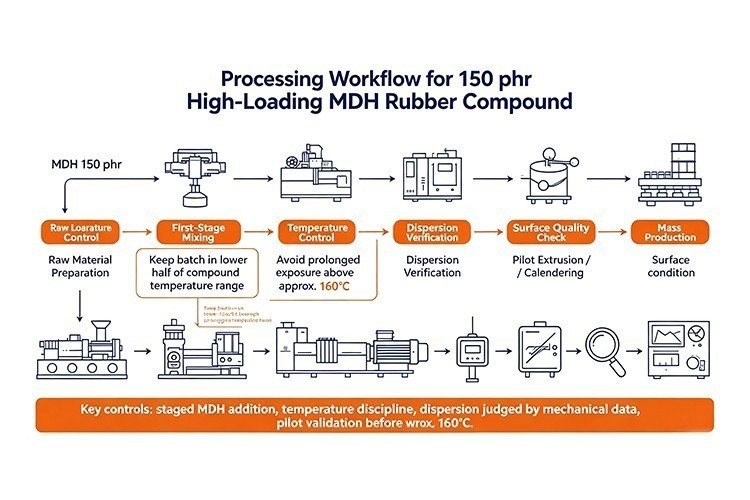
Practical points from the mixer: add MDH in two stages, and keep the batch in the lower half of the compound’s temperature range — above roughly 160°C, shear heat combined with the endothermic reaction starts to draw moisture and destabilise the mix. Judge dispersion by tensile and elongation data, not appearance. Confirm surface quality on a pilot extrusion or calendering run; a laboratory sheet tells you little about an eight-hour production day.
Batch consistency and scale-up
⟨anchor: batch-consistency-scale-up⟩
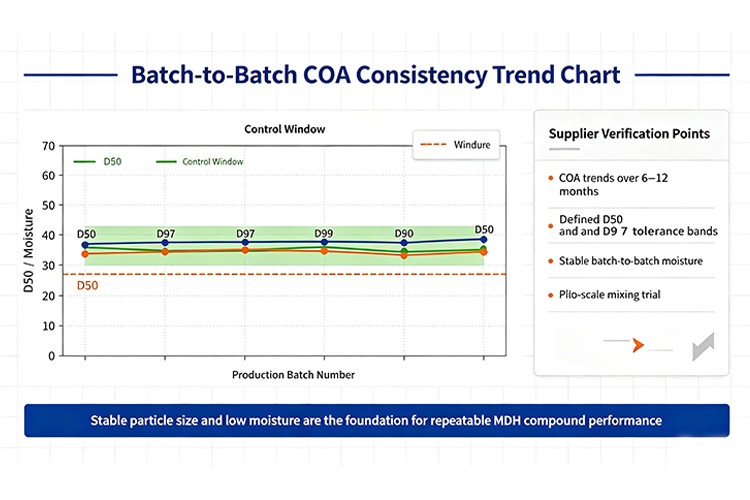
A formulation that works in the laboratory has to survive months of production. Put three things into the supplier conversation early: COA trends across recent lots (6–12 months, not a single sheet); a defined tolerance band for particle-size shift; and a pilot trial on production-scale mixing before the first bulk order. An integrated producer — from ore to finished grade — makes repeatability easier to defend than a trader-based chain.
Frequently asked questions
⟨anchor: faq⟩
Does particle size affect flame retardancy?
⟨anchor: faq-particle-size-fr⟩
Yes. Finer particles increase specific surface area and improve flame efficiency per phr of magnesium hydroxide flame retardant (MDH) — which matters when loading is capped by mechanical limits.
Is brucite-derived MDH pure enough for demanding compounds?
⟨anchor: faq-brucite-purity⟩
With appropriate processing and a controlled impurity profile — particularly low chloride and iron oxide — brucite-derived magnesium hydroxide flame retardant grades meet the electrical and moisture requirements of halogen-free rubber compounds.
How do I verify dispersion in production?
⟨anchor: faq-dispersion-verify⟩
Combine tensile strength and elongation at break trends with surface inspection and microscopy or ash analysis. Consistent D50 in the magnesium hydroxide flame retardant supply is the foundation.
What is the risk of choosing a coarser grade to save cost?
⟨anchor: faq-coarse-risk⟩
Lower viscosity and quicker mixing, but at 150+ phr the costs appear later in any magnesium hydroxide flame retardant compound: reduced strength and elongation, rough surfaces, more production rejects and weaker flame performance.
Supplier reference points
⟨anchor: supplier-reference⟩
When comparing suppliers, the checklist is short: ultra-fine grades with certified D50 1.5–2.5 μm; surface treatments matched to your rubber system; 6–12 months of COA history; and pilot-line support. As a reference point, Victoryfr produces brucite-derived ultra-fine MDH on 15+ production lines at 100,000 t/yr (ISO 9001; SGS and REACH documentation available) — www.victoryfr.com. The same questions apply to any vendor on your list.
If you require formulation support or product datasheets for your rubber project, feel free to reach out for technical consultation.
