

How Victoryfr Ultrafine and Surface-Modified Talc Improve LSZH Cable Surface Quality
How Victoryfr Ultrafine and Surface-Modified Talc Improve LSZH Cable Surface Quality
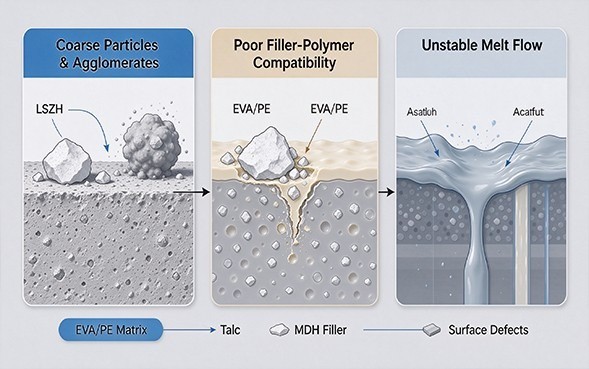
A smooth cable surface depends on more than selecting the finest mineral filler. In low-smoke zero-halogen (LSZH) cable compounds, uneven particle distribution, poor filler dispersion and unstable extrusion can produce visible roughness. These problems become more pronounced in highly filled EVA and PE formulations, where talc, magnesium hydroxide (MDH) and other additives share the same polymer matrix.
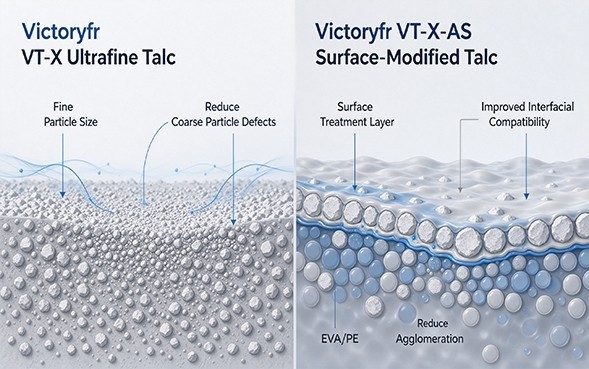
Victoryfr offers two talc routes for different formulation requirements. Talc Powder VT-X focuses on fine mineral distribution, while Modified Talc Powder VT-X-AS improves dispersion and compatibility with polymer matrices, particularly polyolefins. The application goal is to identify the source of surface defects and verify the appropriate material adjustment through extrusion trials. This matters when a formulation already meets its flame-performance target and a change in filler grade must not disrupt the existing MDH system or cable-sheath properties.
How to Address LSZH Cable Surface Defects with the Right Talc Grade
An EVA or PE cable sheath can meet its flame-retardancy requirements but still develop surface roughness during extrusion. Coarse talc particles and agglomerates can disrupt the extruded surface, while poor mineral–polymer interaction may cause uneven filler dispersion even when fine powder is used.
Ultrafine talc addresses particle distribution, while surface-modified talc improves dispersion and interfacial compatibility. Both must perform within the existing MDH loading and extrusion conditions. The first task is to identify whether surface defects originate from oversized particles, insufficient dispersion or unstable melt flow.
Identify the Cause of Surface Roughness
Examine the original compound and record:
● Particle distribution:Coarse particles and agglomerates in the talc.
● Mineral loading:Talc and MDH content.
● Polymer compatibility: Filler dispersion in EVA or PE.
● Extrusion behavior:Melt temperature, pressure and surface appearance.
Visible coarse particles point to particle-size control. Persistent defects despite fine particles direct attention to dispersion or processing conditions.
Compare samples taken before and after extrusion to distinguish agglomerates present in the compound from defects arising at the die.
Use Ultrafine VT-X for Particle-Related Surface Defects
Victoryfr's VT-X talc range is finely ground and offers high purity, whiteness and stable material quality. For light-colored LSZH cable compounds, specifications such as whiteness of 88–90 and loss on ignition of 6–8% can serve as useful reference points when evaluating talc quality and consistency.
For cable compounds targeting a talc D50 of approximately 4 μm, verify the selected grade's particle-size distribution, including D90 or D97, and its dispersion after compounding.
D50 alone cannot describe agglomerates or the coarse-particle tail. Two grades with similar D50 values can produce different extrusion results. Evaluate the powder distribution together with the finished cable surface.
Use VT-X-AS to Improve Filler Dispersion and Compatibility
When finer particles do not resolve roughness, the filler–polymer interface deserves attention. Victoryfr's VT-X-AS uses surface modification to improve talc dispersion and compatibility in polymer matrices, particularly polyolefins.
For a controlled comparison, check:
● Dispersion and visible agglomeration after mixing.
● Melt flow and extrusion pressure.
● Surface appearance of the finished cable.
VT-X-AS provides a route to address interface-related defects without treating particle-size reduction as the only solution.
How Talc Performance Differs in EVA and PE Cable Compounds
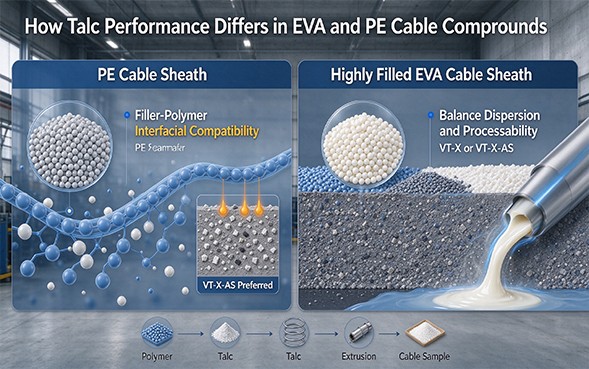
EVA and PE share mineral-filler challenges, but their polymer characteristics influence talc behavior during processing.
PE Cable Sheaths: Focus on Filler–Polymer Interaction
PE is a nonpolar polyolefin. Victoryfr's VT-X-AS targets talc compatibility and dispersion in this type of matrix.
Compare the original and modified compounds for agglomeration, melt-pressure consistency and surface roughness under the same extrusion conditions.
EVA Cable Sheaths: Balance Dispersion and Processability
Highly filled EVA compounds demand control of both filler dispersion and melt behavior.
Evaluate ultrafine or surface-modified talc according to the source of surface defects, then compare extrusion pressure, surface appearance, tensile strength and elongation.
The selected grade must improve the surface without compromising the sheath's required properties.
How to Measure Surface Quality Improvements During Extrusion
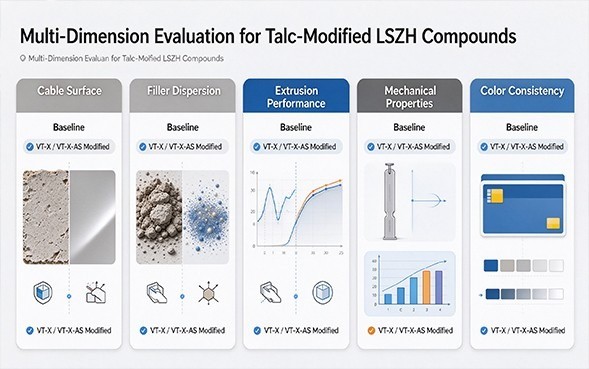
Use the original LSZH formulation as the baseline. Record talc grade, dosage, surface treatment and total mineral loading. Keep the main extrusion conditions comparable to isolate the effect of the talc change.
Where possible, measure roughness at the same points on each sample and document the surface with photographs. A repeatable measurement gives the comparison more value than appearance alone.
Evaluation area | Key parameters | Qualification objective |
Cable surface | Roughness, visible defects, finish | Achieve a more uniform surface |
Filler dispersion | Agglomeration, particle distribution | Improve mineral distribution |
Extrusion performance | Melt pressure, torque, flow | Maintain stable processing |
Mechanical properties | Tensile strength, elongation | Retain required cable properties |
Color consistency | Whiteness, color variation | Meet appearance requirements |
Read the results together: a smoother surface is useful only when processing, mechanical and flame-retardant requirements remain satisfied.
Maintaining Smooth LSZH Cable Surfaces During Continuous Production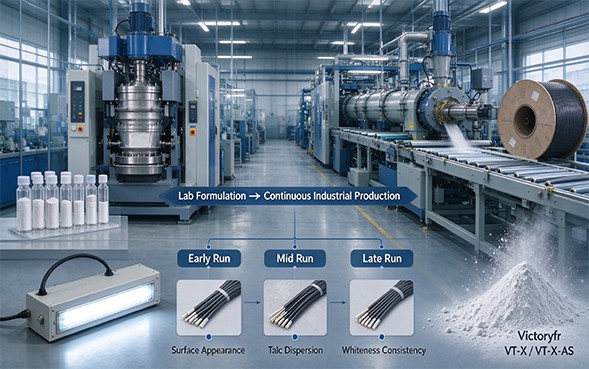
A smooth laboratory sample must be reproduced during longer extrusion runs. Changes in filler quality or processing conditions can affect cable appearance even when the nominal formulation remains unchanged.
Check Repeatability Across Production Batches
Collect samples at the beginning, middle and end of a production run. Compare:
● Surface appearance: Roughness, streaks and visible particles.
● Extrusion stability: Pressure and torque variation.
● Material consistency: Talc particle distribution and surface treatment.
● Color stability: Whiteness and color matching in light-colored sheaths.
Stable mineral whiteness matters in light-colored LSZH cables because filler variation affects final color and pigment adjustment.
Victoryfr's talc portfolio includes fine-particle, high-whiteness and surface-modified options for these application requirements.
FAQ
Does Finer Talc Always Produce a Smoother LSZH Cable Surface?
No. Particle-size distribution matters, but agglomeration, polymer compatibility and extrusion conditions also determine the result. D50 alone is not sufficient.
When Should Surface-Modified Talc Be Used in EVA or PE Compounds?
Use surface-modified talc when dispersion or mineral–polymer interaction limits surface quality. Victoryfr's VT-X-AS is designed to improve compatibility, particularly in polyolefin systems.
How Can Cable Manufacturers Maintain Consistent Surface Quality?
Control mineral specifications and extrusion settings between batches. Compare surface appearance, melt stability and filler dispersion during continuous runs.
Conclusion
Smooth LSZH cable surfaces require control of talc particle distribution, polymer compatibility and extrusion conditions. Ultrafine talc addresses particle-related defects; surface-modified talc targets dispersion and interface limitations. Matching the material treatment to the observed defect avoids repeated adjustments to filler fineness alone.
Victoryfr's VT-X and VT-X-AS represent these two approaches within its talc portfolio. In EVA and PE cable compounds, comparative extrusion trials show which route improves surface appearance while retaining the required processing and mechanical properties. Production-run checks then establish whether that result remains consistent over time. A talc grade earns its place in an LSZH formulation through those comparisons, not through particle size or surface treatment claims alone. This gives cable manufacturers a practical basis for choosing and qualifying a filler grade.
